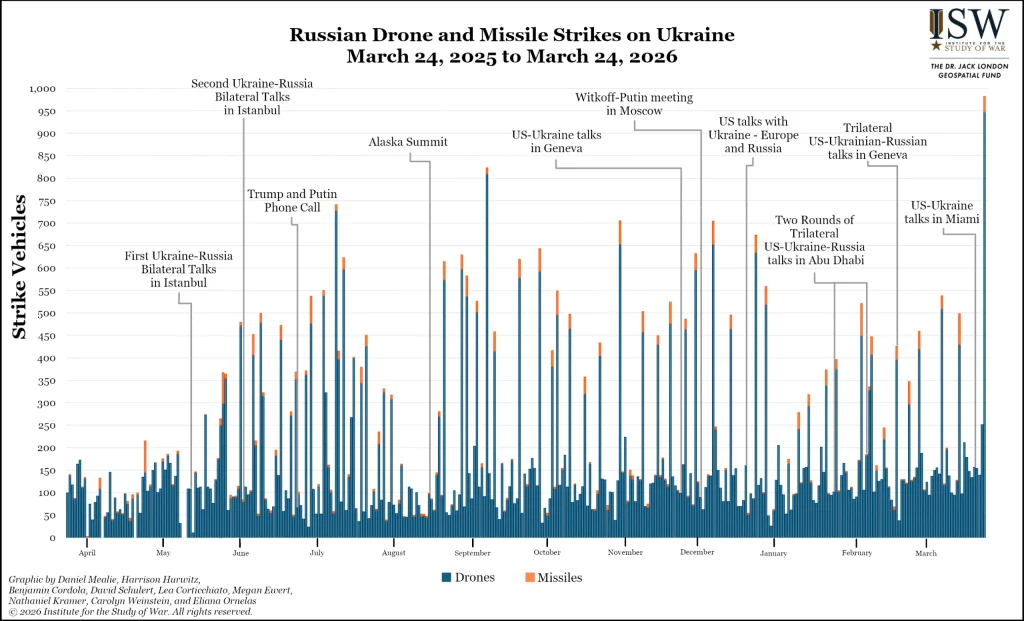
Russian forces launched nearly 1,000 drones and missiles against Ukraine in a prolonged strike series from the evening of March 23 to the evening of March 24 – the largest Russian strike series against Ukraine of the war thus far. The Ukrainian Air Force reported on the morning of March 24 that Russian forces launched 426 drones and missiles against Ukraine from 1800 local time on March 23 to 0900 on March 24 and another 556 drones from 0900 to 1800 local time on March 24.[1] The Ukrainian Air Force reported that Russian forces launched 392 Shahed-type, Gerbera-type, Italmas-type, and other strike drone types and 34 missiles, including seven Iskander-M ballistic missiles/S-300 surface-to-air missiles, 18 Kh-101 cruise missiles, five Iskander-K cruise missiles, and four Kh-59/69/31 cruise missiles overnight, of which Ukrainian forces downed 256 drones and 25 missiles. The Ukrainian Air Force reported that Russian forces did not launch any missiles during the day on March 24 and that Ukrainian forces downed 541 of the 556 strike drones launched during the day. The Ukrainian Air Force reported that Russian forces targeted more areas of Ukraine during the daytime strikes than overnight and that Russian forces launched many drones during the day from the north.[2] Ukrainian Air Force Spokesperson Colonel Yuriy Ihnat stated that Russian forces launched all seven ballistic missiles at areas relatively close to the frontline in Zaporizhia and Poltava oblasts and that Ukrainian forces were unable to intercept the missiles.[3] Ukrainian President Volodymyr Zelensky stated that Russian overnight strikes targeted 11 oblasts and killed at least four civilians.[4] Ukrainian officials reported that Russian strikes overnight and during the day damaged civilian, energy, and transport infrastructure in Chernihiv, Dnipropetrovsk, Ivano-Frankivsk, Kharkiv, Kyiv, Lviv, Mykolaiv, Odesa, Sumy, Vinnytsia, and Zaporizhia oblasts.[5]
Russian forces struck a UN Educational, Scientific and Cultural Organization (UNESCO) World Heritage site in Lviv City during the day on March 24. Russian drones struck the Ensemble of the Bernardine Monastery in central Lviv City during the afternoon, causing a fire.[6] Lviv Oblast Military Administration Head Maksym Kozytskyi stated that specialists are still working to determine the extent of the damage.
The Russian strikes on March 23 to 24 represent a significant inflection in Russian strike tactics that allow Russia to threaten more areas of Ukraine for longer periods of time and disproportionately affect civilian areas. Ukrainian Ministry of Defense (MoD) advisor on defense technology and drone and electronic warfare (EW) expert Serhiy “Flash” Beskrestnov reported on March 24 that the Russian shift in extending the time frame during which Russia delivers its strike packages likely intends to identify vulnerabilities in Ukrainian air defenses and penetrate them.[7] Ukrainian Center for Countering Disinformation Head Lieutenant Andriy Kovalenko reported that Russian forces have been accumulating resources for a “long time” to conduct longer-duration strikes and are deliberately targeting civilian infrastructure, including across Ukraine, including in Dnipro, Lviv, Ivano-Frankivsk, and Vinnytsia cities.[8] Russian forces often launch no or few missiles for multiple days in a row before launching strike packages with a significantly higher quantity of missiles, likely stockpiling missiles between strike series to maximize damage by launching several missiles alongside a large quantity of drones to overwhelm Ukraine’s air defenses.[9] Russian forces have also likely been stockpiling long-range strike drones for a prolonged strike series against Ukraine at a moment of its choosing. Russia reportedly planned to launch strike packages of over 1,000 strike vehicles against Ukraine by fall 2025, and the March 23 to 24 strike series is the closest Russian forces have gotten to this goal.[10] Russia also launches these larger strike packages to coincide with the days before and after bilateral and trilateral peace negotiations, and notably launched this most recent strike package in the days following US-Ukrainian talks on March 21 and 22 in Florida.[11] Russia’s increasingly large and diverse strike packages continue to highlight the critical importance of Western assistance in bolstering Ukraine’s air defense capabilities, both with high-end US-made Patriot air defense systems that can effectively counter Russian ballistic missiles and other lower-end forms of air defense, for a holistic, well-equipped air defense umbrella.[12] Russia likely seeks to take advantage of a global shortage of Patriot interceptors and the current war in the Middle East to escalate its strike campaign against Ukraine.
Ukraine notably disrupted elements of the strike package by destroying ground-based Zirkon hypersonic missile launcher while it was moving into a firing position in Crimea on the night of March 23 to 24 – a difficult task that is a testament to Ukraine’s maturing operational planning and extended-range strike capabilities. Ukraine’s Main Military Intelligence Directorate (GUR) posted geolocated footage on March 24 showing Ukrainian forces striking a column of Bastion-M coastal missile system launchers that were moving toward firing positions in occupied Crimea overnight on March 23 to 24.[13] The GUR reported that the Ukrainian strikes destroyed one launcher and two Zirkon hypersonic cruise missiles, damaged another launcher, and killed seven Russian servicemembers. Russian forces likely intended to launch the two Zirkon missiles as part of their large-scale drone and missile strike series on the night of March 23 to 24. Ukrainian forces struck a Russian Iskander-M ballistic missile launcher that had been preparing to fire at Ukraine in occupied Crimea overnight on March 13 to 14 and have been waging a systematic campaign against air defense assets in the region.[14] Russia’s strike package likely would have been larger and more damaging if not for Ukraine’s campaign aimed at degrading Russian missile strike capabilities.
Russia recently launched satellites as part of its efforts to develop a Russian analogue to Starlink. Russian aerospace company Bureau 1440 announced on March 24 that a launch vehicle successfully deployed the company’s first 16 Rassvet communications satellites into low orbit on the evening of March 23 and that this launch supports Russian efforts to establish a low Earth orbit (LEO) satellite-based broadband communications service.[15] Bureau 1440 stated that it plans to launch “hundreds” more satellites into space across dozens of launches and that the company intends to create a constellation of LEO satellites capable of global coverage. Russian state news outlet RIA Novosti reported that Bureau 1440 intends to start testing low-orbit broadband service in 2026 and officially launch services in 2027, though it is unclear whether Russia will introduce this service in a limited geographical area, such as the theater in Ukraine, or globally.[16] The system is very likely Russia’s attempt to establish a sovereign version of SpaceX’s Starlink, which Russian forces lost access to in Ukraine on February 1.[17] Russian milbloggers emphasized that such a communications system will support Russian military operations against Ukraine and further Russia’s efforts to digitally isolate itself from reliance on Western systems.[18] One Russian milblogger characterized the launch as a “complete failure,” however, claiming that Bureau 1440 was supposed to launch these 16 satellites in December 2025 and that the project has experienced significant delays and a collapse in satellite production.[19] The milblogger noted that Bureau 1440 lacks the production logistics to build the satellites on the large scale required to truly replace Starlink. It remains unclear how effectively the Rassvet communications satellites will replicate the capabilities of Starlink, if at all. Russia may eventually intend to export this communications service to its allies and other interested actors as a non-US-controlled alternative to Starlink, if it is successful.
Key Takeaways
- Russian forces launched nearly 1,000 drones and missiles against Ukraine in a prolonged strike series from the evening of March 23 to the evening of March 24 – the largest Russian strike series against Ukraine of the war thus far.
- Russian forces struck a UN Educational, Scientific and Cultural Organization (UNESCO) World Heritage site in Lviv City during the day on March 24.
- The Russian strikes on March 23 to 24 represent a significant inflection in Russian strike tactics that allow Russia to threaten more areas of Ukraine for longer periods of time and disproportionately affect civilian areas.
- Ukraine notably disrupted elements of the strike package by destroying ground-based Zirkon hypersonic missile launcher while it was moving into a firing position in Crimea on the night of March 23 to 24 – a difficult task that is a testament to Ukraine’s maturing operational planning and extended-range strike capabilities.
- Russia recently launched satellites as part of its efforts to develop a Russian analogue to Starlink.
- Ukrainian forces recently advanced in the Slovyansk direction, in the Kostyantynivka-Druzhkivka tactical area, and in western Zaporizhia Oblast.
- Ukrainian overnight March 22 to 23 strikes halted operations at a Russian oil port for exports.